21 November 2011

Janet Daley said what???

So it turns out Janet Daley is kind of an idiot.


In a recent op-ed in the Telegraph, Ms. Daley says that OWS has "failed the essential test of protest" because its political objectives aren't well-defined, unlike the protests she participated in during the 1960s at Berkeley:
"The abolition of racial segregation in the Southern states of America (and de facto segregation in its Northern ones), the right of black US citizens to register as voters, and opposition to American military action in Vietnam still seem to me to be issues on which it was necessary and right to take a stand. The reason that I find it impossible to feel any kinship with the erstwhile campers of Zuccotti Park – let alone their imitators in London – is not because I repent of my own youth, or no longer accept the value of public protest. There is all the difference in the world between what we did then and what is going on now."
Janet's absolutely right.  There is "all the difference in the world" between then and now.  When she was at Berkeley there was a war going on in Vietnam.  "End the war in Vietnam" was a clear and easily-defined goal, and it fit nicely on a poster.  As for racial segregation in the South, the Civil Rights Act of 1964 was passed in direct response to the concentrated efforts of protesters and civil rights advocates, both in the South and across the United States.  In both of Ms. Daley's examples, it was possible (and relatively easy) for protesters to demand specific, achievable policy changes.

Unfortunately, OWS is attacking a different monster, one that has infiltrated every aspect of our social, political and financial institutions.  You can't write a law that outlaws greed and corruption, and it's not the responsibility of protesters to demand specific policy changes.  I'm sure a philosophy major from Berkeley could suggest a 0.002% financial transactions tax, but what would that number be based on, and who would consider his/her suggestion to be legitimate?

Ms. Daley is pandering to the Telegraph's conservative audience with this piece, and it's annoying that a woman who's smart enough to see the obvious differences between the 1960s and the 2010s is ignoring them for personal gain.

14 November 2011

Are Republicans Earth-Hating Hypocrites?

Well, the GOP is at again, this time trying to pass legislation that would allow border patrol agents to circumvent environmental regulations that protect drinking water and fragile national parks.

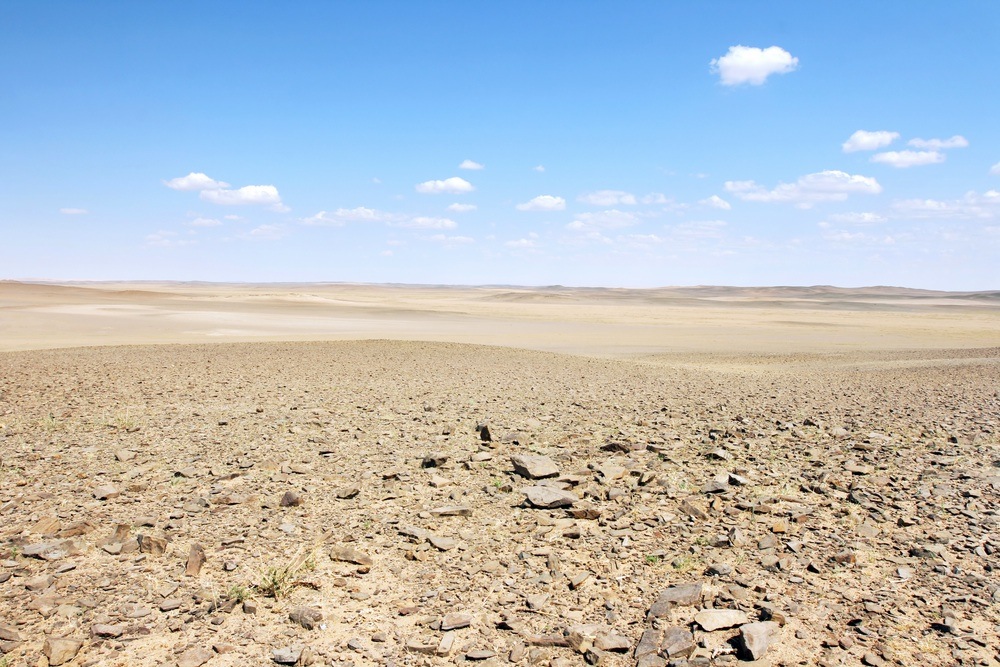
Northern Montana, post "border enhancement"

This is a thinly veiled attempt to wrest even more power from the already frail EPA.  Republicans claim that there's a market solution to pollution, and when certain conditions are met, that's definitely true.  But what they don't realize is that their ultra-conservative anti-government babble is making it impossible to implement successful market-based instruments (MBIs).  Instead, they create obstacles to success, and when environmental policies (undoubtedly) yield ineffective results, they scream "Big government!" and blame it on the left.

The success of MBIs depends on certain institutional structures.  In particular, regulatory agencies must have the power to enforce contracts.  Firm 1 won't be willing to negotiate a carbon trade with Firm 2 if neither of their emissions will be monitored by an independent agent (aka the EPA) because they'd both be better off just lying to the regulators.


So Republicans, if you're going to advocate for the free market, fine.  But be brave enough to craft an institutional framework in which the free market can succeed.  If you shoot your opponent in the leg before the race starts, victory means nothing.


11 November 2011

Hope China doesn't get it...

The State Department has decided to "postpone" its decision on the Keystone XL Pipeline project until an impact assessment of other routes can be completed.  This probably won't happen until 2013, after the presidential election.

Some people have accused Obama of pandering to his base, which threatened immobilization during the 2012 campaign if he didn't concede to their anti-Keystone demands.  I think it's more than that - Keystone XL was opposed by both Democrats and Republicans questioned the safety of a massive oil pipeline crossing sensitive ecosystems and important sources of drinking water.

It's definitely a good idea to make sure the research is sound, as it's possible that there were some conflicting interests surrounding the first Environmental Impact Statement.  Boener is definitely nuts to suggest that "more than 20,000 new American jobs have just been sacrificed".  You can't really sacrifice something you don't have, can you?

Like I said the other day, the Athabasca Oil Sands are nasty, but they're going to be developed whether America buys the oil or not.  We better hope that Joe Oliver and his ilk aren't too trigger-happy with the contracts.  If the oil flows west to China instead of south to Texas and Oklahoma, well....

08 November 2011

Environmentalists Should Support the Keystone XL Pipeline

I was standing at St. Paul's Cathedral on Saturday listening the Occupy LSX rally, when an American hopped up on the podium.  He called on the protesters to abandon their tents for a day and move the demonstration to the American Embassy, where he and some of his friends were planning to publicly express their opposition to the Keystone XL Pipeline project.

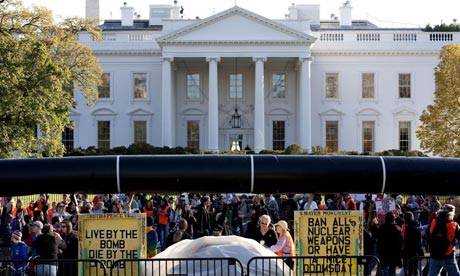
I'm not sure how successful his event was because I was too busy being a graduate student, writing papers on rational choice theory and applying for fellowships, jobs and PhDs, but I read the next day about a rather dramatic campaign in Washington, DC, where thousands of protesters surrounded the White House shouldering a huge rubber replica of an oil pipeline.

Source: Reuters
Keystone XL is a contentious issue in the US, and for good reason.  The pipeline would bisect America, carrying oil from Canada's Athabasca oil sands in Alberta to refineries on the coast of Texas.  It would cross the Ogalalla aquifer, a major source of fresh water for millions of Americans.  The threat of oil spills is low, but credible, and with the Deepwater Horizon catastrophe still fresh on our minds, many Americans are unwilling to accept even the slightest chance of that happening.  A number of prominent environmentalists, as well as a few congressmen, have called on Obama to block the Keystone XL Pipeline.

A question that a lot of people haven't asked, though, is "What happens if the White House does red-light the project?"

Thankfully, Canada's Minister for Natural Resources Joe Oliver has already answered this question for us.  He's made it clear that if Obama doesn't approve the project, they'll just sell the oil to China.  Instead of running vertically across the United States, the pipeline would run horizontally across Canada to shipping ports on the West Coast.  From there, it would be pumped into tankers and shipped across the Pacific Ocean to refineries in China.

That's the last thing we want to happen.

The Chinese government's main priority is economic development, and as people get richer, their energy consumption is rising tremendously:

Source: Chinese National Bureau of Statistics
What China needs is to develop its renewable energy sector, and an economic incentive to do so.  What China does NOT need is unfettered access to one of the world's dirtiest and largest oil reserves.

The Athabasca oil sands are going to be tapped, and there's nothing we can do to stop it.  The question, then, is whether we want the Chinese government or the American government to be responsible for its safe transport to refineries.  I prefer the latter.  Sure, it's the lesser of two evils, but given our options, the choice should be clear.

30 October 2011

We are the 53%

I'm sure by now most of you have seen "We Are The 53%", a silly backlash against Occupy Wall Street that confuses lack of opportunities with laziness.  They chose the number 53 based on a report from the Tax Policy Center that says almost 47% of people pay no federal income taxes.  This number doesn't reflect the reality that the overwhelming majority of those people make less than $20,000 a year, but when you're a hardworking member of the 53%, numbers are a triviality. Oh wait...

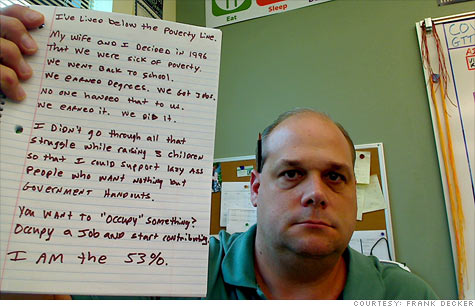
A symbol of this movement is Frank Decker, who claims that he and his wife used to live below the poverty line while raising three children, but then they decided to go back to school and become teachers.  Now that Frank's comfortably middle class, he has a message for the OWS crowd: He does not intend for "lazy ass people" to snatch up his hard-earned tax dollars, which they would no doubt spend on cocaine and prostitutes.

"You want to 'occupy' something?" he asks. "Occupy a job and start contributing [to society]."

Hawt.
Clever, Frank. But one has to ask, how did Frank and his wife manage to improve their lives so quickly? Was it on their own? If they were living below the poverty line in the 1990s, chances are they were already receiving some kind of "government handout".  And when they went to school, it's even more likely that they received federal funding (because they were poor, non-traditional students (read: old) with children) in the form of Pell Grants or other state- and federally-funded scholarships.  I guess those handouts are only okay when they're being handed to you, eh Frank? Again, wrong-wing stupidity right-wing hypocrisy at its finest.

Another member of the 53% - a self-proclaimed "middle aged 'white guy'" who has "personally experienced discrimination and bigotry" [note: he has a two postgraduate degrees, including an MBA, and seems really bitter about something] - claims that he "personally believe[s] that in life we all eventually get what we earn & deserve. It's a natural law, just like gravity."  He also believes that Goldman Sachs executives ride unicorns to work and are paid in rAiNbOwS & hApPiNeSs! Very cute.

Newsflash: If simply deciding not to be poor anymore meant you weren't poor, there wouldn't be any poor people, and the world would be a great place to live.  If "good people" were rewarded for their virtue with more money and a lower Gini coefficient, there would probably be a lot more people in church every Sunday.

But the the truth is, we don't live in a Horatio Alger plot, where poor people can change their ways and suddenly become members of the upper middle class.  It's 2011, and "Ragged Dick" doesn't mean what it used to.

A lot of Republicans think that poor people are poor because they choose to be. No one actually believes this, especially not the Tea Party fruitcakes/leading GOP candidates who espouse it, and anyone who does is an idiot. The system we live in is broken, and it's a shame that the people it's affecting the most - teachers and nurses and police officers - are doing everything in their power to undermine this important and very necessary movement toward greater equality (buzzword!).


Perhaps what's most unsettling about this working class hostility toward the OWS movement is the irony that poor and middle-class people are actually willing to sacrifice their welfare for that of the uber rich.  Everyone knows the marginal utility of a dollar is greater to a poor person than a rich person, and yet many conservative voters - despite facing very tangible financial challenges - are choosing to follow free-marketism to their graves.

So silly.

04 October 2011

How to Talk to the Willfully Ignorant

Talking to people who ignore science and use flawed logic to justify their positions is always fun.  A lot of them are fanatics, and they can't engage in civil debate because, well, most of the time there is no debate to be had.

So when I posted a comment on this well-known "skeptic's" blog post, I wasn't surprised to get some nasty responses. Here was my initial comment:
This is ridiculous. Obama is open to domestic oil production, but it hardly makes him a bad person or an irresponsible leader because he wants to reduce our dependency on oil and produce less GHGs. Quite the contrary, actually. 
Reducing oil use, by definition, reduces the demand for Middle Eastern oil, so it’s hypocritical to argue AGAINST green investment while simultaneously arguing FOR reduced demand for ME oil. It’s always so interesting to hear a righty pick and choose the numbers that support their case.
A high school student who’s sat through just a few hours of introductory economics can tell you that pollution – which relatively simple science has shown, with very high levels of confidence, leads to climate change – is an externality, and that products and processes that are energy/pollution intensive should be taxed or regulated to reflect their true social costs. Any serious economist will agree with this. 
And in response to some of these “corrupt Democrats” comments, please, please don’t get me started. That’s an argument the right will ALWAYS lose. 
Of course you say a word about greenhouse gas emissions to these people, and they go nuts. People on this thread were vicious, which they have to be since their arguments go against an almost universal consensus. They immediately started picking at the science of climate change.  Then they descended to arguing things like (paraphrased) "CO2 isn't a pollutant because we breathe it out and it's made naturally, plus it helps plants grow".  One guy even argued for incandescent bulbs (against their less wasteful alternatives), saying:
The much-derided ‘wasted’ heat thrown off by incandescent lights is often NOT wasted at all! There are many situations when the efficiency of an incandescent bulb approaches 100%, for example in lights that are at lower height levels like lamps where the heat warms the air and rises. 
Arguing that incandescent bulbs are efficient because they can be used as heaters is absurd, but it's obvious that for Tea Party members, that's not really what it's about at all.  Instead, "Blade" asserts that my support for cleaner alternatives - and government regulations to enforce them - shows that "freedom and the Constitution is (sic) [my] enemy." Not exaggerating.


So the arguments continued to devolve, as I presented pretty sound scientific evidence supporting my case, and other commenters ignored it.  To the kind of silly suggestion that CO2 isn't bad because it's produced naturally, I asked about methane and sulfates, which are also found in nature.  That was question was ignored, and I was instead labeled a "carbon demonizer", or something to that effect.

The forum reached its nadir when a moderator used my private information to reveal some personal details about me, including where I go to school (which one commenter has subsequently attacked). I would be pretty upset if I weren't also a very amateur blogger, but when you cross that line of decency, it's hard to take you seriously anymore.  Anthony Watts, a retired TV and radio weatherman, asked if my "supervisor at LSEPS would approve of the use of [my] time to hurl insults." He's obviously not very familiar with the reputation of the School; otherwise he'd be well aware that we rarely even entertain skeptic drivel like his. By the way, friend, we call it the LSE. 

People who enjoy being underdogs, even when it flies in the face of reason, will always be the loudest, and that's a shame.  You show them a report compiled by leading researchers, and they scream that it's liberal, politicized propaganda.  You say something that's actually quite moderate, and they label you an oppenent of American ideals. Their only arguments are buzzwords like "green liberal agenda" and "anti-Constitutionalism" and "liberty," things that rarely have a place in serious dialogue. A sane person argues for a tax on carbon, referencing pretty straightforward science that shows, yes, CO2 is a greenhouse gas.  Deniers respond by screaming "there's no proof!" (there is) or "you're a liberal, elitist mouthpiece for the Obamunists!" (I'm not.) As we discussed in class today, misinformation is just another form of market failure, and it's ironic that the people who worship the free market are the same people rendering it ineffective.

It's sad that rational scientific and economic debates like climate sensitivity, emissions trading and green technology are so easily undermined by these cranks.  Instead of focusing on the real issues, scientists have to waste time defending what we already know - time that should be spent figuring out what we don't. 

For the record, here are some of my views:
  • Green technology should compliment existing infrastructure, but as we continue to develop, we should focus on exploring alternative forms of energy instead of relying on outdated technology that science has shown has and will continue to have negative effects on our well-being.
  • Obama should stand up and say "We are going to do this because it's the responsible thing to do." Climate change is real, and even if you haven't been personally convinced of its existence, you should respect the vast amount of scientific research that supports it.  Personal decisions should reflect the fact that the best available science makes a clear case for anthropogenic climate change.
  • The economics of climate change is complicated, but certain ideas are not. It is the government's responsibility to protect its citizens from private interests, whether that's air and water pollution or energy security, and pollution taxes are, as the Economist put it, an "elegant solution to a complicated problem."  Polluters should pay more for the right to pollute, as those who are adversely affected by their harmful emissions usually go uncompensated.  Only then will the price of pollution reflect its true social costs.
So how do you talk to the willfully ignorant? The answer is simple. 

You don't, because they don't want to learn.